Blog
Copper certification results explained: what your test report means
A certification report is the proof your cabling performs to its category. Here's what each measurement means, how to read the results and the common causes of failures.
JASS Networks team · Published · 5 min read
Certification is not a continuity test
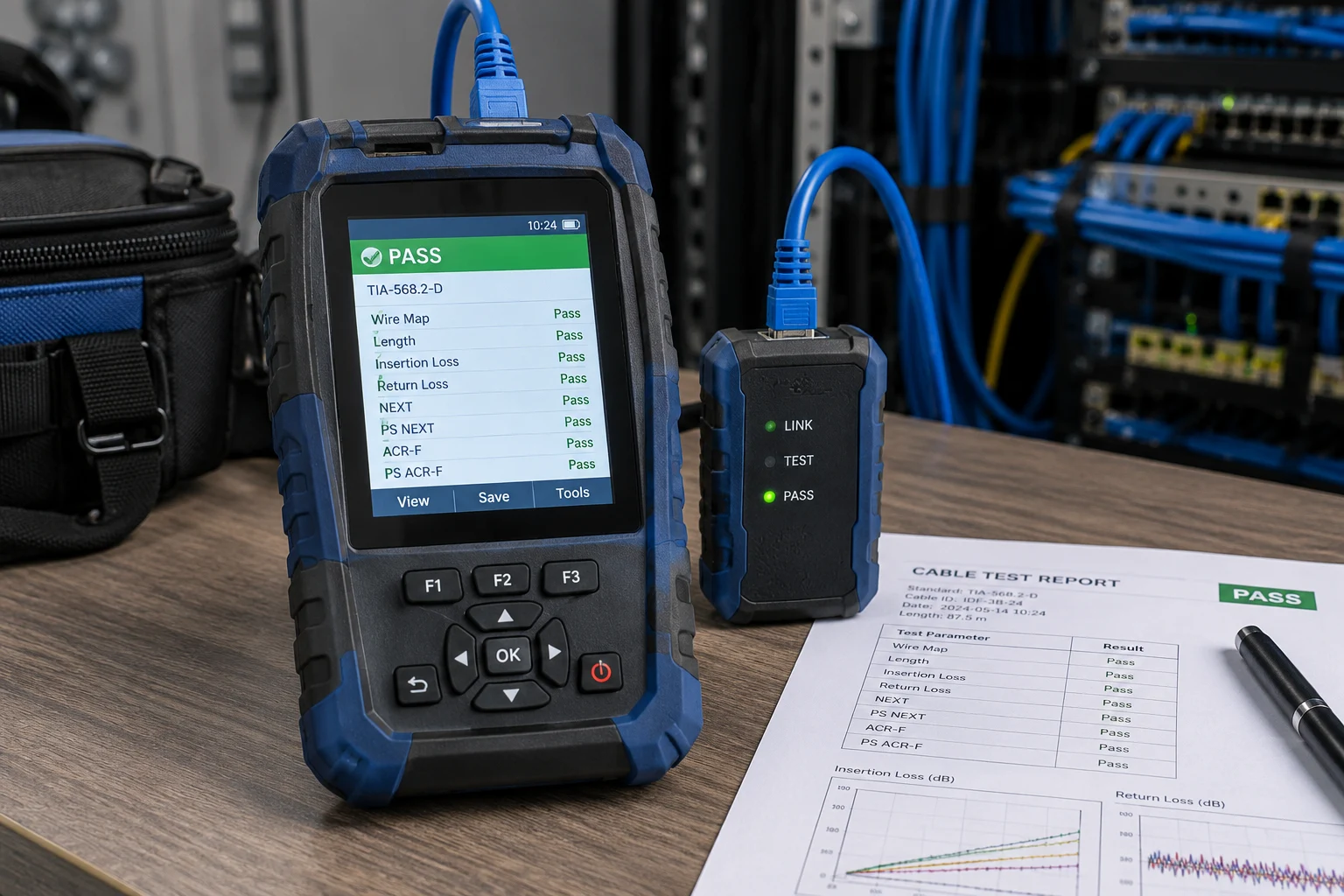
A simple cable tester confirms that each wire is connected to the right pin. Certification goes much further: it measures how well every link carries high-frequency signals and compares the results with the limits for its category, such as Cat6 or Cat6A.
A link can pass a continuity test and still fail certification — and then fail in use when traffic or speeds increase.
What the tester measures
- Wiremap: every pair is terminated correctly, with no crossed, open, shorted or split pairs.
- Length, propagation delay and delay skew: how long the signal takes on each pair, and the difference between the fastest and slowest pairs.
- Insertion loss: how much signal is lost along the link.
- NEXT and PS-NEXT: crosstalk between pairs, measured pair by pair and as the combined effect of all pairs.
- Return loss: signal reflected back by changes in impedance, often caused by poor terminations or damaged cable.
- Resistance: the DC resistance of each pair, which also matters for Power over Ethernet.
Permanent link or channel?
The permanent link is the fixed cabling from the patch panel to the outlet — the part that stays in the building. The channel adds the patch cords at each end. Most specifications certify the permanent link, because that is what the installer builds and warrants; patch cords can be replaced at any time.
Reading pass, fail and margin
Each measurement is compared with a limit, and the report shows the margin — how far the worst result sits inside or outside that limit. A healthy installation passes with margin to spare.
Some testers mark results that fall within their own measurement accuracy with an asterisk. Treat these as a reason to look closer rather than as a clean pass.
Common causes of failures
- Pairs untwisted too far at the termination, which raises crosstalk.
- Tight bends, or cable crushed by over-tightened zip-ties, which affect return loss.
- Split pairs or wiring errors at the jack or panel.
- Runs longer than the standard allows.
What to keep from the handover
Store these with your building records:
- A result for every link, using identifiers that match the labels on outlets and panels.
- The test standard and limit used, and whether links were tested as permanent links or channels.
- The tester model and its calibration date.
- The original Fluke .FLW files, so results can be re-opened and re-checked later.
Planning a project like this?
Tell us about your site and we'll recommend the right approach — from survey and design to installation and certified handover.